


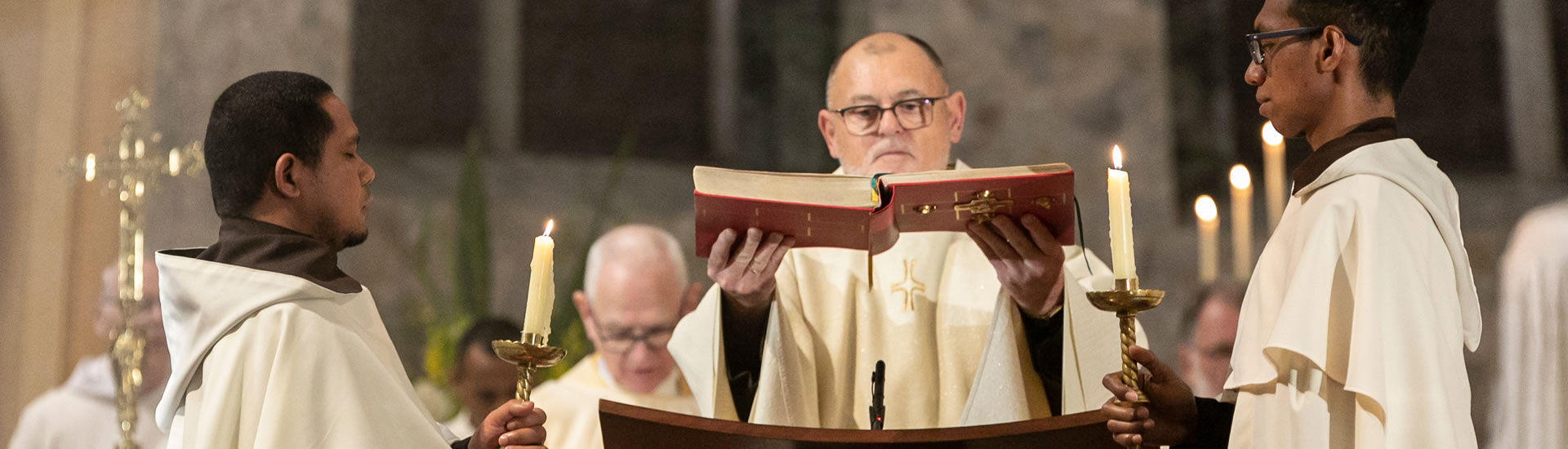



Fr Hilary Januszewski
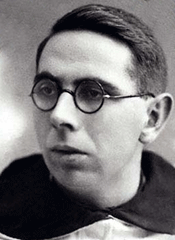 "Faithful in little, faithful in much…."
A letter by Fr Joseph Chalmers Prior General of the Carmelites on the occasion of beatification of Fr Hilary Januszewski, O.Carm.
13 June 1999
Dear brothers and sisters in Carmel,
The Holy Father, Pope John Paul II, during his next apostolic visit to Poland, will beatify 108 martyrs who were victims of the nazi persecution during World War II. Among them is our brother, Father Hilary Januszewski.
Dachau and the Carmelites
Along with some magnificent human, scientific, social and political achievements, the twentieth century, now drawing to a close, will leave us with a number of dreadful names: Auschwitz, Hiroshima, Verdun, Rwanda and others, each an example of the horror, barbarity and disregard for humankind which has also marked this century. Dachau is one of those names. It was the first concentration camp opened by the national-socialism, back in March 1933, on the premises of a former arms factory. It was also practically the last one to be freed, on 29 April 1945. The name of this noble barbarian town, near Munich, famous for its nineteenth-century school of painting and the hospitality of its people, became forever linked to the Lager (concentration camp).
On 16 July 1942 an unusual clandestine ceremony was held to celebrate the feast of Our Lady of Mount Carmel. Several Carmelites, from different parts, were imprisoned at the camp at the same time in the huts reserved for the clergy. That morning, at dawn, before setting out for their forced labour, they joined hands to celebrate with joy, despite the appalling nature of the circumstances, the fact that even there they could be and persevere sub tutela matris.
One of them was Father Titus Brandsma, a Dutch Carmelite, journalist and lecturer at the University of Nimega (of which he was Rector Magnificus), imprisoned for defending the rights of the Catholic press against the forces of domination and for trying to save a group of Jewish children. He was beatified by John Paul II in November 1985. One of his companions was Brother Raphael Tijhuis, who was with him during the last days of his life and who was the main witness of these dramatic events.[1]
Father Albert Urbanski was also there. He was a Polish Carmelite who was to write some beautiful letters to the Curia General in Rome shortly after the camp was liberated in May 1945, describing his experiences over the years in which he was deprived of his freedom and the most basic rights. He set an example by putting himself at the service of the Order right from the beginning.[2] Urbanski wrote one of the first accounts of the camp and the priests’ life there.[3] After the War, he did some marvellous work in several positions of responsibility. He was provincial from 1964 to 1967. He was the first president of the Studium Josephologiae Calissiae (under the Polish Studium Mariologiae).[4]
Several other Polish Carmelites were imprisoned at the camp. Some of them survived the hell of Dachau, although they came out of it severely marked by the experience, both physically and psychologically. Others, however, lost their lives there. Among them we find Father Leon Michail Koza, who died on the vigil of Ascension Day in 1942 through exhaustion owing to the tough labour in the fields;[5] Father Szymon Buszta, who died a few weeks after Father Koza, also as a result of physical and psychological exhaustion [6] and Father Bruno Makowski.[7] Together with them, we should mention G. Kowalski, who died in Auschwitz in November 1940, while waiting to be transferred to Dachau [8].
Father Hilary Januszewski, the one who will soon be beatified by Pope John Paul II, was also there. He is the second Carmelite of this century to be beatified, which is a source of deep satisfaction for the whole Carmelite family.
Father Hilary Januszewski
Father Januszewski was born in Krajenki on 11 June 1907. He was christened Pawel and educated in the Christian faith by his parents, Martin and Marianne. After going to school in Greblin (where the family lived from 1915), he continued his studies at the secondary school (Gimnasium) in Suchary, which he had to leave later because of financial difficulties in the family. After periods at other schools, he went to Krakow, where he did a number of courses (including correspondence courses) and joined the Order of the Our Lady of Mount Carmel in September 1927, whereupon he changed his name to Hilary. After his noviciate, he took his vows on 30 December 1928 and moved to Krakow to do his studies for the priesthood. After these studies he was sent to Rome to study at St. Albert’s International College. There he lived with Carmelites from all over the world who were concerned with how the situation in Europe was becoming increasingly complicated and how tension was rising all the time. The young Hilary proved to be a silent and prudent man, who loved studying. People could sense in him a deep inner life and a wealth of spiritual experience, as some of his colleagues, including Prior General, Father Kilian Healy [9], were to indicate later on. He was ordained on 15 July 1934. In Rome, he came into contact with a generation of Carmelites who were to mark the history of the Order during this century: Xiberta, Brenninger, Esteve, Grammatico, Driessen and others.
Upon his return to Poland, he was appointed lecturer in Dogmatic Theology and in Church History for the students of the Polish province in Krakow. In 1939 he was appointed Prior of that community by the provincial, Father Eliseo Sánchez Paredes, one of the Spanish Carmelites who had been sent to Poland to help in the restoration of this province.
World War II was to jeopardise all the hopes and projects of the young prior. On September 1, 1939, after several months of widespread international tension, Germany declared war on Poland. It was the beginning of a terrible month in the recent history of Poland. Twenty days later, Soviet troops launched an attack from the East. A weak Polish army surrendered on both fronts at the end of that month. Poland was once again humiliated and divided. Mass deportations, destruction, annihilation of Jewish communities followed in quick succession. The Polish clergy did not escape this persecution. A year after the invasion, the invading forces ordered the arrest of large numbers of monks and priests. The Carmelites in Krakow were particularly hard hit: on September 18 A. Urbanski, A. Wszelaki, M. Nowakowski and P. Majcher were all arrested, to be followed shortly afterwards by the prior of the community H. Januszewski, who offered to go instead of P. Konoba, who was older than him and sick. Father Januszewski acted heroically without stopping to consider the consequences of his action, guided by his conscience and his Christian and religious values, by what he considered to be his obligation as the head of a Carmelite community. He was arrested and, after some time at the Montelupi prison in Krakow and several concentration camps, he ended up at Dachau.
During the severe winter of 1945, news began to filter through that the German army was growing weak and that there was a possibility of retreat and even of freedom. Life at the camp had become unbearable. In addition to the normal conditions, there were constant threats of bombings and reduced rations. The kapos (prisoners in charge of working parties) were continually on edge, intensifying beatings and other forms of repression.
Hut 25 was being used to group together, in the most inhumane conditions, all the prisoners with typhus fever, who were constantly growing in number. The camp authorities offered the Polish priests the opportunity to put their "theories" of Christian charity into practice and look after the typhus patients. Freedom was by then imminent and the risk of death in the wretched hut 25 was very high. However, the silent Carmelite was one of the first volunteers.
What he said to his friend Father Bernard Czaplinski (later the Bishop of Chelm) shortly before he set off for the hut leaves one very moved even today: You know I won’t come out of there alive….[10]
Sure enough, Father Januszewski never left Dachau alive. After 21 days serving the sick, he died of typhus. Hut 25 had become a coffin, which the Americans, who freed the Lager a few days later, found crammed with hundreds of corpses.
His testimony for us today
The beatification of Father Januszewski is a source of joy and happiness for all Carmelites. The Church has considered one of our brethren an intercessor and an example, a valid witness for the universal Church. This is an occasion for Carmelites not only to feel that joy and to celebrate it, but also to reflect upon and to think deeply about Father Januszewski’s testimony, to find in his example keys to our own way of living today.
First of all, there is a good example in the biography of Father Januszewski of a selfless, quiet, silent life, founded upon deep prayer and service of others. Those who knew him insist that he was remarkably simple. Had it not been for his heroic death, he would probably have been forgotten, because he never stood out in extraordinary things.[11] But with that strength that grows from a life of prayer, acting in the presence of the Lord - something very typical and genuine in Carmelite spirituality - he gave himself up for others with the same simplicity with which he lived a quiet, hard-working life. A person educated in daily devotion generously offered his life when faced with arrest and the reality of the concentration camp. We could say that he succeeded in being faithful to his vocation in ordinary circumstances and, as a result, was also able to be just as faithful in truly extraordinary circumstances. Faithful in very little, he was faithful also in much (Lk 16, 10).
Father A. Urbanski, with whom he was joined both in religious life and in fate, writing to the Carmelite Curia in Rome from the camp during the forced quarantine following liberation, interpreted his death as follows:
Proh dolor R.P. Hilarius Januszewski, die 26.3.45, uno Mense ante liberationem, tanquam victima zelus sacerdotalis erga infectuose infirmos, mortuus est.[12]
As this century draws to a close, we are horrified by certain events that have taken place during it. We find the experience of the concentration camps in which Father Januszewski lost his life especially cruel and inhuman. However, there are situations even now that are, in a way, very similar: racial hatred, poverty and starvation, wars of all kinds, massacres, intolerant violent nationalist movements… The testimony of Father Januszewski invites the Carmelites of the twenty-first century to make a radical option for life, which nowadays is threatened in so many ways. He was able to do this in the most sublime way, giving up his own life for that of others.[13]
Father Januszewski’s example reminds us that Carmelites are called to vouch for life in the midst of a "culture of death", which shows itself in many different ways, not only in those regions of the world in which that "culture of death" is more obvious, but also in other areas where its presence is more subtle. Moreover, in the face of the temptation of "usefulness", of valuing human beings for what they produce, and eliminating those who are no longer useful and become a burden, Father Januszewski opted radically for the dying, the useless, those who apparently had nothing left to offer. With this action, he proclaimed and testified to the sacred value of human life, for itself and in itself. This witness given by Hilary Januszewski went to the ultimate limit, the giving of his own life.
We also find in Father Januszewski an especially interesting example for our experience of the Carmelite charism today. Januszewski, a man of silence and prayer, accustomed to talking to God, devoted to contemplation -like any good Carmelite - had no difficulty in finding the face of Christ in the weak, the needy and the suffering. In the awful conditions of Dachau, those with typhus fever, the dying, were the poorest of the poor and Father Januszewski, along with other priest volunteers, was willing to stay with them and end up dying with them and for them.
A life of intense prayer makes us more human and more capable of living in solidarity with others; it gives us the necessary intuition and sensitivity to discover the mysterious presence of the Lord in those who are weakest, in the midst of the tensions and contradictions of life. Like John in the boat on the Lake of Galilee, between the darkness of the passing night and the light of dawn, the Carmelite is called to proclaim, humbly but firmly: It is the Lord (Jn 21, 7).
Finally, the witness of Hilary Januszewski, soon to be called blessed must show Carmelites throughout the world the meaning of the international dimension of our Order. We must not forget that most of the patients Father Januszewski looked after were Russians (that is, from an enemy country). But this, seemingly, did not affect his decision. Overcoming national barriers, Father Januszewski offers us a true witness to universal fraternity, to reconciliation between enemy nations, and to peace.
Three years earlier, Blessed Titus Brandsma had ended a document, requested of him as part of the investigation into the opposition of Dutch Catholics to national-socialism, with the following words: God save Holland! God save Germany! Let God make these two nations walk in peace and freedom once again and recognise his Glory!
May the example and intercession of these two blessed Carmelites help us to enter the twenty-first century with a real spirit of service, peace and justice born out of a true and intense encounter with our Risen Lord.
Rome, 19 March 1999
Solemnity of St. Joseph
Fr Joseph Chalmers, O.Carm.
Prior General
Footnotes
1 R. TIJHUIS, Met Pater Titus Brandsma in Dachau: Carmelrozen 31-32 (1945/46) 18-21, 53-58, 80-85. The English translation may be consulted in: Dachau Eye-witness, in: AA.VV., Essays on Titus Brandsma [R. Valabek, ed.] (Rome 1985) 58-67.
2 F. MILLAN ROMERAL, Carmelitas en Dachau: las cartas del P. A. Urbanski, desde el lager, en el 50 aniversario de la liberación: Carmelus 42 (1995) 22-43.
3 A. URBANSKI, Duchowni w Dachau (Krakow 1945).
4 Cf. JUAN BOSCO DE JESÚS, Dos figuras de la Josefología en Polonia recientemente desaparecidas: PP. Alberto Urbanski, O.Carm. (1911-1985) y Estanislao Ruminski (1929-1984): Estudios Josefinos 40 (1986) 91-98.
5 Cf. Necrología (Obituary): Analecta O.Carm. 11 (1940-1942) 219; A. URBANSKI, Duchowni w Dachau, 61-66.
6 Cf. Necrología (Obituary): Analecta O.Carm. 12 (1943-1945) 230; A. URBANSKI, Duchowni w Dachau, 65-66.
7 Cf. Necrología (Obituary): Analecta O.Carm. 12 (1943-1945) 230; A. URBANSKI, Duchowni w Dachau, 61-66.
8 His photographs may be seen in the splendid photograph album published recently by the Carmelite Province of Poland: R. RÓG, Duch, Historia, Kultura (Krakow 1997) 68-69.
9 K. HEALY, Prophet of Fire (Rome 1990) 181-184 (Italian and Spanish versions available)
10 In the same sense, see the testimony of: F. KORSZYNSKI, Un vescovo polacco a Dachau (Brescia 1963) 125. This is the Italian translation (with a preface by the then Cardenal Montini) of Jasne promienie w Dachau (Poznan 1957).
11 Cf. K. HEALY, Prophet of fire (Rome 1990) 181-184.
12 F. MILLAN ROMERAL, Carmelitas en Dachau: las cartas del P. A. Urbanski, desde el lager, en el 50 aniversario de la liberación: Carmelus 42 (1995) 37. In another letter, written in German, he insists on this: "Als Opfer zelus sacerdotalis ist er gestorben" (ibid. 42).
13 Cf. R. VALABEK, Greater Love Than This... Father Hilary Januszewski, O. Carm.: Carmel in the World 30 (1991) 209-216.
Publications
Australian Carmelite Publications
International Carmelite Publications
Documents of the Carmelite Order
- Carmelite Constitutions
Approved by the General Chapter 1995 - Journeying With Carmel
Extracts from the Carmelite Constitutions 1995
Letters of the Prior General
- pdf Into the Land of Carmel - 25 May 2002
- The God of Our Contemplation - 1 January 2005
- pdf Passion for Christ, Passion for Humanity - 9 January 2005
- pdf That Carmel May Bloom - 27 March 2005
- The Lord Hears the Cry of the Poor - 1 March 2006
- pdf Blessed Maria Teresa Scrilli - 8 September 2006
National Shrine of Our Lady of Mt Carmel
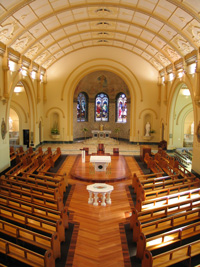 The National Shrine of Our Lady of Mount Carmel is located at the corner of Richardson and Wright Streets in Middle Park, Victoria, Australia.
This Church of Our Lady of Mount Carmel was begun in 1912 and completed in 1928. It was dedicated as the National Shrine in 1944 and has been home to the Carmelite family in Australia since then.
Throughout the year special events are held at the Shrine during which we pray for the members of our Carmelite family and their needs.
These masses include the
- Mothers' Mass, celebrated on the Feast of Our Lady of Mount Carmel
- Mass of Remembrance, celebrated near to All Souls Day and All Saints Day
- Thanksgiving Mass, celebrated at midnight on Christmas Eve
The Church contains shrines to:
- Our Lady of Mount Carmel
- St Therese of Lisieux
- St Mary of the Cross Mackillop
- The Prophet Elijah
- The Sacred Heart
and is open 8.30-9.30am Tuesday, Thursday & Saturday mornings and 4.30-6.00pm Saturday evenings & 10.00am-12.00pm on Sundays.
For more information about how you can be part of these special events please contact the This email address is being protected from spambots. You need JavaScript enabled to view it.
Links
Europe
Asia
USA
...
| International |  |
|
|
||
|
||
|
||
|
||
|
||
|
||
|
Australia & East Timor |
|
|
|
|
||
|
|
||
|
|
||
|
|
||
|
|
||
|
|
||
|
|
||
|
Argentina
|
|
Carmel in Argentina |
|
Bolivia
|
|
|
|
Brazil |
|
|
|
|
Homepage of the Pernambuco Province | |
|
Czech Republic |
|
|
|
France |
|
|
|
Germany |
|
|
|
Great Britain |
|
|
|
|
Carmelite Institute of Britain & Ireland | |
|
India
|
|
Homepage of the Indian Province |
|
Indonesia |
|
|
|
Ireland |
|
|
|
|
Carmelite Institute of Britain & Ireland | |
|
Italy |
|
|
|
|
Homepage the Province of Naples | |
|
|
Carmelite Institute, Rome | |
|
Malta |
|
|
|
Netherlands |
|
|
|
|
||
|
Peru |
|
|
|
Poland |
|
|
|
Portugal
|
|
|
|
Spain
|
|
Homepage of the Arago-Valentina Province |
|
United States of America |
|
|
|
|
||
|
|
||
|
|
The Carmelitana Collection | |
| Centre for Carmelite Studies, CUA, Washington | ||
|
|
||
Carmelite Library
Carmelite’s National Treasure
It has been called “a national treasure” but for well over 100 years it has been accessible to just a few.
Now that has changed. The Carmelite Library – Australia’s finest specialised collection of books and journals in the area of Christian spirituality and mysticism – has a permanent home in Middle Park.
And it welcomes both “the scholar and the seeker” to make use of its rich resources.
The Carmelite friars arrived in Australia from Ireland in the early 1880s and brought with them the nucleus of today’s Carmelite Library.
Among its treasures were the Ceremoniale of 1616 which guided the priest through the intricacies of celebrating mass according to the Order’s ancient Rite of the Holy Sepulchre which dated to the time of the Crusades; and the Carmelite Constitutions of 1625 (reprinted 1721) then still in force.
In 1928 the Carmelites began training their Australian novices and students in Melbourne rather than send them to Ireland. An academic library began to develop at Whitefriars House of Studies, which was first in Kew and from 1937 in Donvale.
It included the textbooks and other works required by the students and their professors across a broad philosophical and theological range. By the 1980s financial pressures, the development of new theological centres and the Order’s changing educational strategy prompted a change of policy and focus.
In 1985 it was decided to discontinue collecting across the whole range of theological disciplines and today the library is concentrated in three areas closely associated with the life and spirit of the Order. These are:
- Carmelitana: all aspects of the life, history and spiritual tradition of the Order;
- Spirituality: the Christian spiritual and mystical tradition, both historical and contemporary, and its links to other world spiritual traditions;
- Mariology: the theological study of the Virgin Mary.
The Rare Book Collection includes about 300 pre-1800 titles, most of them with a Carmelite connection. The oldest book, a controversial work against Lutheranism by the Italian Carmelite Giovanni Maria Verrato, dates from 1538.
In 2003 the Library contained some 30,000 books and other items and is housed in the heritage Carmelite Hall next to the Church of Our Lady of Mount Carmel, Middle Park, where the Carmelites have ministered since 1882.
New Management
The Carmelites know the library requires further development if it is to realise its potential as a cultural, intellectual and spiritual resource for the Australian community. To this end, the Carmelites have formed a partnership with the University of Divinity for the management of the Library from October 2023 to December2024. During this time the University team will work with the Carmelite Library Interim Board to collaboratively develop recommendations as to the most appropriate long-term structure for the library's operation.
Open again
To enable the University team to prepare for this project, the Carmelite Library was closed to the public on 28 September 2023 and reopened on 6 February 2024.
- You can email This email address is being protected from spambots. You need JavaScript enabled to view it. with any enquiries.
- You can visit the Library website by clicking here.
- You can access the Library catalogue by clicking here.
Carmelite Library
214 Richardson Street, Middle Park, Victoria 3206 Australia
Tel : (03) 9682 8553
Email: This email address is being protected from spambots. You need JavaScript enabled to view it.
Open Tuesdays 10am - 3pm
Carmelite Calendar
Download the Carmelite Liturgical Guide for this year -
pdf
2026 Carmelite Liturgical Guide [PDF] |
default
2026 Carmelite Liturgical Guide [ePub]
JANUARY
3 St Kuriakos Elias Chavara (CMI), Priest, Optional Memorial in India
8 St Peter Thomas, Bishop, Feast
9 St Andrew Corsini, Bishop, Feast
20 Bl. Angelo Paoli, Priest, Optional Memorial, Memorial in Italy
29 Bl. Archangela Girlani, Virgin, Optional Memorial in Italy
FEBRUARY
1 Bl. Candelaria of St Joseph, Virgin, Optional Memorial in Latin America
MARCH
19 St Joseph, Spouse of the Virgin Mary, Principal protector of the Order, Solemnity
APRIL
17 Bl. Baptist Spagnoli, Priest, Memorial
MAY
4 Bl. Angel Prat Hostench & Companions, Martyrs, Optional Memorial
5 St Angelus, Priest and Martyr, Memorial
8 Bl. Aloysius Rabatà, Priest, Optional Memorial
9 St George Preca, Priest, Optional Memorial
16 St Simon Stock, Religious, Optional Memorial
22 St Joachina de Vedruna de Mas, Religious, Optional Memorial
25 St Mary Magdalene de' Pazzi, Virgin, Feast
JUNE
12 Bl. Hilary Januszewski, Priest and Martyr, Optional Memorial
14 St Elisha, Prophet, Memorial
JULY
4 Bl. Maria Crocifissa Curcio, Virgin, Optional Memorial in Italy
9 Bl. Jane Scopelli, Virgin, Optional Memorial
13 St Teresa of Jesus 'de Los Andes' (OCD), Virgin, Optional Memorial in Latin America
16 Blessed Virgin Mary of Mount Carmel, Solemnity
17 Bl. Teresa of St Augustine and Companions (OCD), Virgins and Martyrs, Optional Memorial
20 St Elijah, Prophet, Solemnity
24 Bl. John Soreth, Priest, Memorial
26 St Joachim and St Anne, Parents of the Virgin Mary, Protectors of the Order, Memorial
27 St Titus Brandsma, Priest and Martyr, Memorial
AUGUST
7 St Albert of Trapani, Priest, Feast
9 St Teresa Benedicta of the Cross (OCD), Virgin and Martyr, Memorial (Feast in Europe)
12 Bl. Isidore Bakanja, Martyr, Optional Memorial
17 Bl. Angelus Augustine Mazzinghi, Priest, Optional Memorial
25 Bl. Mary Baouardy of Jesus Crucified (OCD), Virgin, Optional Memorial
26 Bl. Jacques Retouret, Priest and Martyr, Optional Memorial
SEPTEMBER
1 St Teresa Margaret Redi (OCD), Virgin, Optional Memorial
17 St Albert of Jerusalem, Bishop and Lawgiver of Carmel, Feast
OCTOBER
1 St Thérèse of the Child Jesus (OCD), Virgin and Doctor of the Church, Feast
15 St Teresa of Jesus, Virgin and Doctor of the Church, Feast
NOVEMBER
5 Bl. Frances d'Amboise, Religious, Optional Memorial
6 St Nuno Alveres Pereira, religious, Memorial
8 St Elizabeth of the Trinity (OCD), Virgin, Optional Memorial
13 Bl. Maria Teresa Scrilli, Virgin, Optional Memorial in Italy
14 All Carmelite Saints, Feast
15 Commemoration of all Carmelite Souls
19 St Raphael of St Joseph Kalinowski (OCD), Priest, Optional Memorial in Poland
29 Bl. Denis of the Nativity (OCD), Priest and Martyr, and
Bl. Redemptus of the Cross (OCD), Religious and Martyr, Optional Memorial
DECEMBER
5 Bl. Bartholomew Fanti, Priest, Optional Memorial
14 St John of the Cross, Priest and Doctor of the Church, Feast
As approved by the Dicastery for Divine Worship and the Discipline of the Sacraments
18 November 2021
Change of Titus Brandsma (27 July) from Optional to Obligatory Memorial approved by the Dicastery for Divine Worship and the Discipline of the Sacraments
25 May 2023
History of the Carmelite Order
 Origins & growth
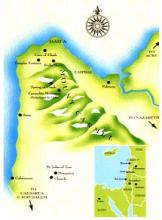
The Order of Carmelites has its origins on Mount Carmel, in Palestine, where, as we read in the first Book of Kings, the great prophet Elijah defended the true faith in the God of Israel, when he won the challenge against the priests of Baal. It was also on Mount Carmel that the same prophet, praying in solitude, saw the small cloud which brought life-giving rain after the long drought. From time immemorial, this mountain has been considered the lush garden of Palestine and symbol of fertility and beauty. Indeed, "Karmel" means "garden".
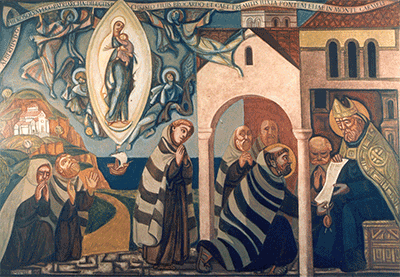
In the 12th century (perhaps after the third crusade, 1189-1191), some pilgrims who had come from Europe, came together near the "spring of Elijah", in one of the narrow valleys of Mount Carmel, to live out their Christianity as hermits after the example of the prophet Elijah in the very land of our Lord Jesus Christ. Then and in later times, the Carmelites did not acknowledge anyone in particular as their founder, but remained faithful followers of Elijah who was associated with Mount Carmel through biblical events and through Greek and Latin patristic tradition which saw in the prophet one of the founders of the monastic life. In the middle of the cells they built a chapel which they dedicated to Mary, Mother of Jesus, thus developing a sense of belonging to Our Lady as Patroness, and they became known by her name as "Brothers of Saint Mary of Mount Carmel". Thus Carmel is deeply associated with Elijah and Mary. From Elijah the Carmelites inherited a burning passion for the living and true God and the desire to make His Word intimately their own in order to witness to Its presence in the world; with Mary, the Mother of God, they are committed to live "in the footsteps of Jesus Christ" with the same intimate and deep feelings which were Mary's.
In order to have some juridical stability, this group of lay hermits turned to the Patriarch of Jerusalem, Albert Avogadro (1150-1214), who was then living at St John of Acre near Mount Carmel. Between 1206-1214, Albert wrote for them a formula of life. Successive approvals of this formula of life by various Popes helped the process of transforming the group into a Religious Order, a fact which took place at the time of the definitive approval of the text as a Rule by Innocent IV in 1247. Thus the Carmelite Order took its place alongside the Mendicant Orders.
However, about 1235, the Carmelites were forced to abandon their place of origin due to the incursions and persecutions of the Saracens who were reconquering the Holy Land from the crusaders. Most of them went back to their country of origin in Europe.
Soon they increased and flourished in the sciences and in holiness. Later some women attached themselves to the monasteries of the friars and in 1452 became cloistered nuns living in their own communities.
Reform & development
In the 15-16th centuries there was some relaxation of discipline in various communities, a fact greatly opposed by Priors General such as Blessed John Soreth (+1471), Nicholas Audet (+1562) and John Baptist Rossi (+1578), and by some reforms (among others those of Mantua and Monte Oliveti in Italy and of Albi in France) to put a stop to the spread of the abuses and the mitigations. The most famous reform is certainly the one started in Spain by St Teresa of Jesus for the reform of the nuns and then, helped by St John of the Cross and Fr Girolamo Gracian, for the reform of the friars. The most relevant aspect of this reform of Teresa is not so much that she opposed the mitigations introduced in the life of Carmel, but rather her ability to integrate in her project, vital and ecclesial elements of her time. In 1592 this reform, called that of the "Discalced Carmelites" or of the "Teresians", became independent from the Carmelite Order and grew rapidly in the congregations of Spain and Italy which were then united in 1875. Thus there are two Orders of Carmelites: "The Carmelites", also known as of the "Ancient Observance" or "Calced", and "The Discalced Carmelites" or "Teresians" who consider St Teresa of Jesus their reformer and foundress.
In spite of this division, during the following centuries the Carmelite Order continued its spiritual journey. Many illustrious men and women gave new spirit to Carmel with their own spirituality and genius. There was also significant development among the laity with the institution of the Carmelite Third Order and the Confraternities of the Scapular of Our Lady of Mt Carmel throughout the world. With the Reforms of Touraine in France, and of Monte Santo, Santa Maria della Vita, Piedmont, and Santa Maria della Scala in Italy, in the XVII and XVIII centuries the movement for a stricter observance spread everywhere.
At the dawn of the French Revolution, the Carmelite Order was established throughout the world with 54 Provinces and 13,000 religious. But as a result of the French Revolution the Order suffered great losses, such that at the end of the 19th century it was reduced to 8 Provinces and 727 religious. But it was this small band of religious who during the 20th century, with determination and courage, re-established the Order in places where it had been and also planted the Order on new continents.
The Carmelite Order today
Since the time of the Second Vatican Council (1962 - 1965), Carmelites have reflected at length on their identity, on their charism, on what is fundamental in their lives and what is for them a "life-project", namely "to live a life of allegiance to Jesus Christ and serve him faithfully with a pure heart and a good conscience" (Rule). They found their allegiance to Christ in their commitment to seek the face of the living God (contemplative dimension), in living in fraternity and service (diakonia) in the midst of the people. They see all this in the lives of the prophet Elijah and the Blessed Virgin Mary who were led by the Spirit of God. Looking at Mary and Elijah, it is easy for the Carmelites to understand, to interiorise, to live and to announce the truth that makes a person free.
Carmelites, conscious of being part of the Church and of history, live in a fraternity that is open to God and to people, able to listen and give an authentic response to the evangelical life according to their own charism, and they commit themselves to build the Kingdom of God wherever they are. Indeed they are committed to evangelisation in houses of prayer, centres for spiritual exercises, parishes, Marian sanctuaries, schools, religious associations; and to Justice and Peace wherever human dignity is trodden underfoot, especially among the poor, the marginalised, the suffering.
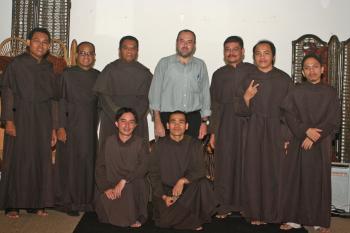 To this vast and varied challenge of the Carmelite friars, one will find in close collaboration: communities of cloistered nuns, Congregations of sisters, Consecrated Lay people, numerous groups of Third Order Lay members and Confraternities of the Scapular of Our Lady of Mt. Carmel. All these groups, born of the Spirit throughout the centuries, and inspired by the Carmelite Rule are intimately united by the bond of love, of spirituality and of the communion of spiritual goods. They constitute the Carmelite Family in the Church. At present the Carmelite Order (the friars) is formed of Provinces, General Commissariats, General Delegations, Hermetical Communities and an Affiliated Community with a total of about 2,000 religious. They are found in all the continents.
Contact Us
Please click on the tabs below to scroll through our contact details.
Provincial Centre
Carmelite Provincial Office
75 Wright Street
Middle Park Vic 3206
Tel: +61 3 9699 1922
Email: This email address is being protected from spambots. You need JavaScript enabled to view it.
Prior Provincial
Father Bruce Clark, O.Carm.
Province Executive Assistant
Ms Belinda Ahearn
Business Manager
Mr Joe Konynenburg
About the Lay Carmelites
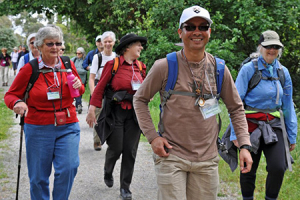
Since our beginnings in the 13th century, Carmelites have sought to follow Christ in a fraternal community united in a spirit of contemplative prayer and our desire to be of service to God and to the people among whom we live. The Lay Carmelites are just what the name implies: lay men and women who form an integral part of the Carmelite family and try to live out the Carmelite way of life in the ordinary circumstances of our family and social life.
Carmelite Rule
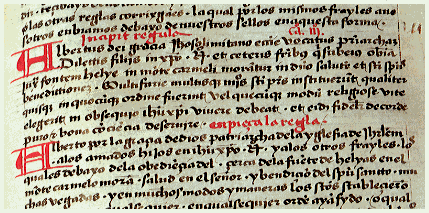 A rule of life was given to the early Carmelites by St Albert Avogadro, Patriach of Jerusalem between the years 1206 - 1214. It was finally approved by Pope Innocent in 1247 and later underwent mitigations which were not in the original text.
The Carmelite Rule states that is basic for a Carmelite to "live a life of allegiance to Jesus Christ - how, pure in heart and stout in conscience, he must be unswerving in the service of his Master" [no.2].
The Rule outlines the way to live out the Carmelite life in allegiance to Christ, according to the spirit of the Order. We are to ponder the law of the Lord, by day and by night, in silence and in solitude, so that the word of God may dwell abundantly in the hearts and on the lips of those who profess it. We are to pray with perseverance, especially by keeping vigil and praying the psalms. We are also to be clothed in spiritual armour; to live in fraternal communion, expressed through the daily celebration of the Eucharist, through fraternal meetings in chapters, through shared ownership of all material goods, through fraternal and loving correction of failings, and through a life of austerity, with work and penance, rooted in faith, hope and love, always conforming one’s own will to God’s, sought in faith through dialogue and through the prior’s service to his brothers. (Carmelite Constitutions n.11)
To live a life of allegiance to Jesus Christ, the Carmelites bind themselves especially to:
- develop the contemplative dimension of their life, in an open dialogue with God
- live as brothers, full of charity
- meditate day and night on the Word of the Lord
- pray together or alone several times a day
- celebrate the Eucharist every day
- do manual work, as Paul the Apostle did
- purify themselves of every trace of evil
- live in poverty, placing in common what little they may have
- love the Church and all people
- conform their will to that of God, seeking the will of God in faith, in dialogue and through discernment.
The Carmelite Rule is the shortest of all known Rules, almost exclusively made up of biblical precepts. To this day it is a rich source of inspiration for life.
TEXT OF THE CARMELITE RULE
[1]
Albert, called by God's favour to be Patriarch of the Church of Jerusalem, bids health in the Lord and the blessing of the Holy Spirit to his beloved sons in Christ, B. and the other hermits under obedience to him, who live near the spring on Mount Carmel.
[2]
Many and varied are the ways in which our saintly forefathers laid down how everyone, whatever his station or the kind of religious observance he has chosen, should live a life of allegiance to Jesus Christ - how, pure in heart and stout in conscience, he must be unswerving in the service of his Master.
[3]
It is to me, however, that you have come for a rule of life in keeping with your avowed purpose, a rule you may hold fast to henceforward; and therefore:
[4]
The first thing I require is for you to have a Prior, one of yourselves, who is to be chosen for the office by common consent, or that of the greater and maturer part of you. Each of the others must promise him obedience - of which, once promised, he must try to make his deed the true reflection - and also chastity and the renunciation of ownership.
[5]
If the Prior and the brothers see fit, you may have foundations in solitary places, or where you are given a site suitable and convenient for the observance proper to your Order.
[6]
Next, each one of you is to have a separate cell, situated as the lie of the land you propose to occupy may dictate, and allotted by disposition of the Prior with the agreement of the other brothers, or the more mature among them.
[7]
However, you are to eat whatever may have been given you in a common refectory, listening together meanwhile to a reading from Holy Scripture where that can be done without difficulty.
[8]
None of the brothers is to occupy a cell other than that allotted to him, or to exchange cells with another, without leave or whoever is Prior at the time.
[9]
The Prior's cell should stand near the entrance to your property, so that he may be the first to meet those who approach, and whatever has to be done in consequence may all be carried out as he may decide and order.
[10]
Each one of you is to stay in his own cell or nearby, pondering the Lord's law day and night and keeping watch at his prayers unless attending to some other duty.
[11]
Those who know how to say the canonical hours with those in orders should do so, in the way those holy forefathers of ours laid down, and according to the Church's approved custom. Those who do not know the hours must say twenty-five 'Our Fathers' for the night office, except on Sundays and solemnities when that number is to be doubled so that the 'Our Father' is said fifty times; the same prayer must be said seven times in the morning in place of Lauds, and seven times too for each of the other hours, except for Vespers when it must be said fifteen times.
[12]
None of the brothers must lay claim to anything as his own, but you are to possess everything in common; and each is to receive from the Prior - that is from the brother he appoints for the purpose - whatever befits his age and needs.
[13]
You may have as many asses and mules as you need, however, and may keep a certain amount of livestock or poultry.
[14]
An oratory should be built as conveniently as possible among the cells, where, if it can be done without difficulty, you are to gather each morning to hear Mass.
[15]
On Sundays too, or other days if necessary, you should discuss matters of discipline and your spiritual welfare; and on this occasion the indiscretions and failings of the brothers, if any be found at fault, should be lovingly corrected.
[16]
You are to fast every day, except Sundays, from the feast of the Exaltation of the Holy Cross until Easter Day, unless bodily sickness or feebleness, or some other good reason, demand a dispensation from the fast; for necessity overrides every law.
[17]
You are to abstain from meat, except as a remedy for sickness or feebleness. But as, when you are on a journey, you more often than not have to beg your way, outside your own houses you may eat foodstuffs that have been cooked with meat, so as to avoid giving trouble to your hosts. At sea, however, meat may be eaten.
[18]
Since man's life on earth is a time of trial, and all who would live devotedly in Christ must undergo persecution, and the devil your foe is on the prowl like a roaring lion looking for prey to devour, you must use every care to clothe yourselves in God's armour so that you may be ready to withstand the enemy's ambush.
[19]
Your loins are to be girt with chastity, your breast fortified by holy meditations, for as Scripture has it, holy meditation will save you. Put on holiness as your breastplate, and it will enable you to love the Lord your God with all your heart and soul and strength, and your neighbour as yourself. Faith must be your shield on all occasions, and with it you will be able to quench all the flaming missiles of the wicked one: there can be no pleasing God without faith; and the victory lies in this - your faith. On your head set the helmet of salvation, and so be sure of deliverance by our only Saviour, who sets his own free from their sins. The sword of the spirit, the word of God, must abound in your mouths and hearts. Let all you do have the Lord's word for accompaniment.
[20]
You must give yourselves to work of some kind, so that the devil may always find you busy; no idleness on your part must give him a chance to pierce the defences of your souls. In this respect you have both the teaching and the example of Saint Paul the Apostle, into whose mouth Christ put his own words. God made him preacher and teacher of faith and truth to the nations: with him as your leader you cannot go astray. We lived among you, he said, labouring and wary, toiling night and day so as not to be a burden to any of you; not because we had no power to do otherwise but so as to give you, in your own selves, an example you might imitate. For the charge we gave you when we were with you was this: that whoever is not willing to work should not be allowed to eat either. For we have heard that there are certain restless idlers among you. We charge people of this kind, and implore them in the name of our Lord Jesus Christ, that they earn their own bread by silent toil. This is the way of holiness and goodness: see that you follow it.
[21]
The Apostle would have us keep silence, for in silence he tells us to work. As the Prophet also makes known to us: Silence is the way to foster holiness. Elsewhere he says: Your strength will lie in silence and hope. For this reason I lay down that you are to keep silence from after Compline until after Prime the next day. At other times, although you need not keep silence so strictly, be careful not to indulge in a great deal of talk, for as Scripture has it - and experience teaches us no less - sin will not be wanting where there is much talk, and he who is careless in speech will come to harm; and elsewhere: The use of many words brings harm to the speaker's soul. And our Lord says in the Gospel: Every rash word uttered will have to be accounted for on judgement day. Make a balance then, each of you, to weigh his words in; keep a tight rein on your mouths, lest you should stumble and fall in speech, and your fall be irreparable and prove mortal. Like the Prophet, watch your step lest your tongue give offence, and employ every care in keeping silent, which is the way to foster holiness.
[22]
You, brother B., and whoever may succeed you as Prior, must always keep in mind and put into practice what our Lord said in the Gospel: Whoever has a mind to become a leader among you must make yourself servant to the rest, and whichever of you would be first must become your bondsman.
[23]
You other brothers too, hold your Prior in humble reverence, your minds not on him but on Christ who has placed him over you, and who, to those who rule the Churches, addressed these words: Whoever pays you heed pays heed to me, and whoever treats you with dishonour dishonours me; if you remain so minded you will not be found guilty of contempt, but will merit life eternal as fit reward for your obedience.
[24]
Here then are the few points I have written down to provide you with a standard of conduct to live up to; but our Lord, at his second coming will reward anyone who does more than he is obliged to do. See that the bounds of common sense are not exceeded, however, for common sense is the guide of the virtues.
Carmelite Charism
A charism is a gift from God to the Church for the world. With regard to a Religious Order, the term refers to the gift which God gives to an individual or group to inspire the founding of a new religious family within the Church. This gift is handed down through the centuries and enriched by all who are called to live it. The charism of each religious family is the particular way in which its members are called to follow Christ. Since all Christians follow Christ, the charisms will have many elements in common, but the way in which these elements are emphasised gives each religious group its unique feel. All religious families have been asked by the Church to rediscover their original founding charism and make it come alive in each culture and in every age.
The charism of the Carmelite Order is God's gift given originally to those nameless hermits who gathered together on Mount Carmel, beside the well of Elijah, at the end of the 12th and beginning of the 13th centuries. The Carmelite Order has no known founder but sprang from the desire of those first hermits to follow Christ together with a pure heart and a good conscience. They asked the Patriarch of Jerusalem, St Albert, to write for them a rule of life (c.1206-1214) which laid down certain guidelines based on the previous way of life of the hermits.
This Rule of St Albert and the experience of the Carmelites as they sought to be faithful to it in various circumstances gave definitive shape to the charism. We can say that there are several elements which make up the Carmelite charism. Firstly, and most importantly, it is a way of following Christ with total dedication. Carmelites do this by seeking to form contemplative communities at the service of God's people in whose midst they live. Fraternity, service and contemplation are therefore essential values for all Carmelites.
Fraternity
Carmelites seek to form communities where each person feels accepted and valued not for what he can do but simply because he is. This kind of community is in itself a witness that the love of Christ can break down the barriers which human beings set up and that it is possible for people of different backgrounds and nationalities to live together in peace and harmony. Carmelites are also aware of being part of an international fraternity which is present in many parts of the world.
Service
The hermits were forced to leave their home on Mount Carmel and settle in Europe. There they changed their style of life from hermits to friars. The major difference is that friars are called to serve the People of God in some active apostolate. Some Religious Congregations were founded for a specific work but the Carmelite Order tries simply to respond to the needs of the Church and the world which differ according to time and place, and so, many friars work in parishes, schools, universities, retreat centres, prisons, hospitals etc. The kind of service which each individual friar is involved in will depend on the needs of the people in whose midst he lives and his own particular talents.
Contemplation
The heart of the Carmelite charism is prayer and contemplation. The quality of our prayer determines the quality of the community life and the quality of the service which is offered to others. The goal of the Carmelite life is union with God. We seek to live in God's presence and consent to God's will for us. This involves us in listening to God who speaks to us in many ways and especially in the words of Scripture. Prayer is the way we relate to God and as we grow in friendship with Christ our prayer will tend to become more and more simple. The relationship with Christ will change us, impelling us to move out of the prison of selfishness towards the bright daylight of pure love for God and our fellow men and women. We are called to embark on a journey of faith whereby we are gradually stripped of all that is not God so that we can put on Christ. We do all we can to respond to God's initiative in calling us but we are very aware that in the end only God can change our hearts and so we learn to wait patiently for the coming of God to us. As we follow Christ along this path of trust in God we are inspired by the example and virtues of Mary, the mother of Jesus, and the Prophet Elijah.
Prayer and contemplation for the Carmelite are not private matters between the individual and God but are to be shared with others since the charism is given for the whole world. Therefore there is an emphasis in the Order on the ministry of teaching prayer and giving spiritual direction. The Carmelite is aware that the transformation of the human heart by God may be hidden from most eyes but has far reaching consequences for our world. The way of prayer is mysterious and goes beyond our normal human categories. Prayer opens us to the Ultimate Mystery.
Mary and Elijah
As we attempt to follow Christ more closely, we Carmelites find inspiration in the Old Testament Prophet, Elijah, and in the Blessed Virgin Mary.
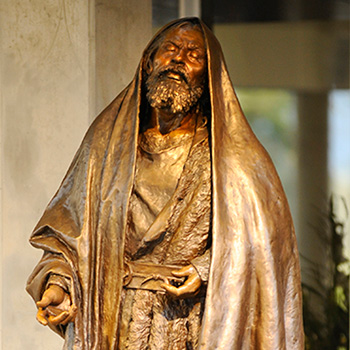 The Prophet Elijah
Elijah's memory was kept alive especially on Mount Carmel where he challenged the people to stop hobbling first on one foot and then on the other but to choose who is God in Israel - Yahweh or Baal. According to the story, which can be found in the First Book of Kings, chapter 18, Elijah's sacrifice was consumed by fire from heaven which proved to the people that Yahweh was the true God.
Elijah in the presence of the Lord on Mount Horeb
Elijah made himself available for God's work and was sent into various situations to proclaim God's word. Elijah undertook a long journey through the desert where he began to despair. He sat down under a bush and wished he were dead but God would not allow him to die and prodded him to continue his journey to Mount Horeb. When he arrived there, God became present to Elijah. God came not with the signs usual in the Old Testament of fire, earthquake and mighty wind but in the sound of a gentle breeze. Elijah was sent back to his people to carry out God's will.
From Elijah, Carmelites learn to listen for the voice of God in the unexpected and in silence. We seek to allow the Word of God to shape our minds and our hearts so that the way we live and the things we do may be prophetic and therefore faithful to the memory of our father Elijah.
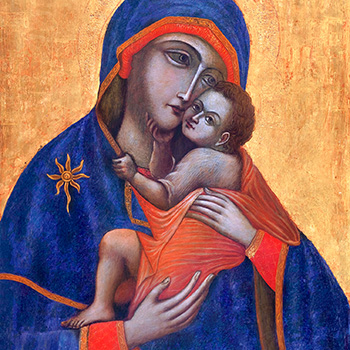 The Blessed Virgin Mary
The first hermits on Mount Carmel built a church in the middle of their cells. This was the centre of their lives where they converged each day to celebrate Mass together. This little church they named in honour of Our Lady. By this fact the first group of Carmelites took her as their patroness, promising her their faithful service and expecting her protection and favour. They were proud to bear the title of "Brothers of the Blessed Virgin Mary of Mount Carmel" and they defended this title with vigour when their right to it was challenged.
Mary ever ready to accomplish the wish of God
Mary consented to God's will when she was asked to be the mother of the Saviour. She pondered on the events of her life and was able to see in them the hand of God at work. Mary did not become proud about her unique vocation but instead praised God for looking on her lowliness and doing great things in her. She was with Jesus at the beginning of his public ministry when, at the marriage feast at Cana, she made known to him the simple need, "They have no wine". She was with him as he died and there she became the mother of all believers. At the beginning of the Acts of the Apostles we find Mary gathered in the upper room praying with the other disciples waiting for the outpouring of the Holy Spirit. For us Carmelites, Mary is a constant presence in our lives, guiding us and protecting us as we seek to follow Christ.
The brown scapular has for many centuries summed up the Carmelite's relationship with Our Lady. The scapular is a piece of cloth based on the traditional Carmelite friar's garb. Wearing the scapular is a sign of consecration to Mary, the Mother of God, and is a symbol showing that the person is putting on the virtues of Mary and is being protected by her.
Mary symbolises for the Carmelite everything that we hope for - to enter into an intimate relationship with Christ, being totally open to God's will and having our lives transformed by the Word of God. Carmelites have always thought of Mary as the Patroness of the Order. We seek to live in spiritual intimacy with her so that we can learn from her how to live as God's children.
Elijah and Mary are inspirational figures for all Carmelites. They play a very important part in the life and spirituality of the Order which sees itself as belonging to Mary and looks to Elijah as our spiritual father.
Prayers for Discernment
Lord Christ,
you have no body on earth but ours,
no hands but ours,
no feet but ours.
Our are the eyes through which your compassion
must look out on the world.
Ours are the feet by which you may still
go about doing good.
Ours are the hands with which
you bless people now.
Bless our minds and bodies,
that we may be a blessing to others.St Teresa of Avila - Carmelite
***********************
O Lord God,
I have no idea where I am going,
I do not see the road ahead of me,
I cannot know for certain where it will end.Nor do I really know myself,
and that fact that I think
I am following Your will
Does not mean that I am actually doing so.
But I believe
that the desire to please You
does in fact please You.
And I hope I have that desire in all that I am doing.I hope that I ill never do anything
apart from that desire to please You.
And I know that if I do this
You will lead me by the right road,
though I may nothing about it.
Therefore I will trust You always
though I may seem to be lost and in the shadow of death,
I will not fear,
for You are with me
and You will never leave me to make the journey alone.Thomas Merton - Cistercian
************************
O God, you have created us (me)
to do some definite service;
you have given some definite work to us (me)
which you have not given to any other.
We (I) a place in your plan.
We may never know what it is in this life
but we shall be told it in the next.
Therefore we (I) will trust you in all things.
If we are sick, our sickness may serve you.
If we are worried, our worry may serve you.
If we are in sorrow, our sorrow may serve you.
Nothing is in vain:
all things serve your purpose.
We may lose our friends and find ourselves among strangers;
we may feel forgotten so that our spirits may sink;
our future may be hidden from us;
still, you work in all things for good,
and we (I) trust you.Cardinal John Henry Newman
For further information please contact Carmelite Vocations.
Making a Decision
It can be difficult at times to know exactly how to go about making a decision.
Here are some simple steps to guide your decision-making.
Begin by acknowledging who I am before God at this point in my life.
At the start of this time I present myself before God with empty hands.
- Clearly define the choices that lie before you.
- Make a list of the pros and cons of each choice.
- Take some quiet time and pray with this list.
- What motives are drawing you to choose one choice over another?
- Are these motives in line with you value system?
- Are you now experiencing peace with the choice you made?
- If not, share your experience with a trusted friend and ask some input.
- Take some additional time to pray asking the Spirit for guidance.
- When the right decision comes, peace and joy can be signs that the choice is right for you
For further information please contact Carmelite Vocations.
Finding Direction
Where are you going?
Do you know how to get there?
Here are four simple steps to help you find direction in your life:
- First, pray for direction, spend time in a quite place.
- Talk with others, consider your gifts, seek direction from your pastor or priest, a parent, or a spiritual guide.
- Listen to your feelings - do you know where you find discomfort, or what brings you discouragement? Where do you find satisfaction? What gives you energy for living? What brings you peace and joy?
- Above all, trust in who you are and know that God loves you and wants the best for you.
For me prayer is an aspiration of the heart,
it is a simple glance directed to heaven,
it is a cry of gratitude and love in the midst of trial
as well as joy.
Finally, it is something…. Which expands my soul
And unites me to Jesus.St Therese of Lisieux - Carmelite
For further information please contact Carmelite Vocations.
The Carmelite Story
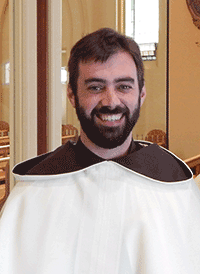
We do not know exactly when the forbears of the Order of Carmelites first came to Mount Carmel: it was around the year 1200 AD. They settled in a small valley on the western slope of the mountain, near a spring known since antiquity as the "spring of Elijah".
The Carmelites shared many of the spiritual aspirations of the hermits and pilgrims in the Holy Land at the time of the Crusades: the commitment to poverty and simplicity of lifestyle, their desire for spiritual freedom, their intimacy with the Scriptures and their longing to hear the Word of God in the quiet of solitude, the central place given to love, their wish to build a brotherhood in which they could learn to see Jesus in each other.
These values continue to inspire Carmelite life today.
The Carmelite travels the most demanding journey of all … the journey inwards into one’s own heart.
As Prophetic Contemplatives …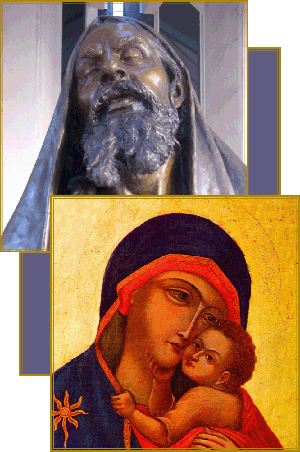
Carmelites find inspiration in the persons of Elijah, prophet of Mount Carmel, and Mary, the first disciple of the Lord.
Like them, Carmelites create an open space in themselves in order to recognise God, and so embark on the most demanding of all journeys, the journey into one’s own heart. As prophets they are called to share this experience of God with all people.
In Ministry …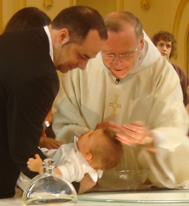
Carmelites work in many and varied ways … Welcoming people to participate in their life and spirituality in…
parish life hospitality education & formation
spirituality ministry communications retreat work
 Through Our Life Together…
Carmelites are called to share their commitment to Christ within a community.
They live a common life — sharing their time, their income, their wisdom, their talents, their prayer. The way of poverty, chastity and obedience offer great freedom to live life fully.
Download our pdf vocations brochure.
Finding out what God wants – Discerning My Personal Vocation
Discernment is experiencing with understanding and commitment
the presence and guidance of God in my whole life….
Ernest Larkin, O.Carm
For further information please contact:
Dili
Fatuhada - Blessed Titus Brandsma Community
Blessed and opened in July 2005, Blessed Titus Brandsma House serves as the main administration centre for the Carmelites. It is the only Carmelite house with a postal service. It is a 'transit house' for Carmelites and other visitors travelling between the parish of Zumalai and Dili.
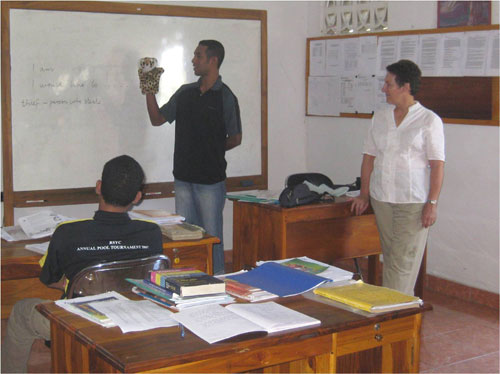 Blessed Titus Brandsma Community is also the formation house for the Pre-Novices - young men beginning their formation as Carmelites. The two-year pre-Novitiate is an introduction to Carmelite life and formation and a time of deeper discernment. During their second year these students take part in an Inter-Congregational programme for young men and women who are beginning their formation in religious life. The daily programme for the Pre-Novitiate includes attendance at Eucharist, community and personal prayer, manual and pastoral work and sporting activities, studies in English, Portuguese, introduction to scripture and theology, and a programme for human development.
The Carmelite sisters “Hermanas Carmelitas” live nearby so the Carmelite priests celebrate daily Mass for them and also at the Mission Centre.
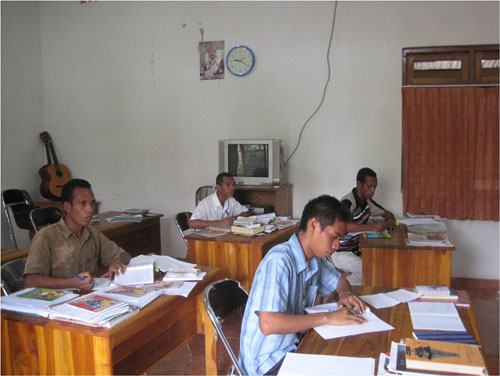 As well as providing accommodation for the Carmelite friars and pre-novices, there are also rooms for male high school students from Zumalai. There are few senior high schools in East Timor. By providing accommodation in Dili for these students, the Carmelites are making it possible for at least some students from Zumalai to complete their secondary or technical education. Most families cannot afford to pay for board and education expenses for their children. The Carmelites are helping these students by providing for their needs while they study. These students with the Pre-Novices also contribute to the daily up-keep of the house and the community.
Fr Carlito Da Costa Araújo looks after the Pre-Novices at Fatuhada.
Hera- Santo Elias Community
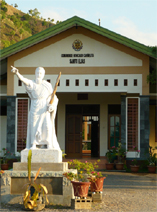 In April 2007 Santo Elias Novitiate in Hera was blessed and opened. Hera is a 20 minute drive east from Dili. Santo Elias was built with generous financial assistance from Australia, Rome, Ireland, Britain and USA. It was a two year project that was managed with patience and hard work with those close by. This beautiful building has 20 rooms for students and novices and 5 rooms for professed Carmelites. Among the rooms there is also a classroom, a small library and a chapel which is large enough to invite the local people to join the community for Mass on Sunday and other feast days. In the grounds a fruit and vegetable garden has been established as well as a soccer field. There are many flowering plants in the internal garden of the Novitiate building, most of which are tended lovingly by our young Carmelite students.
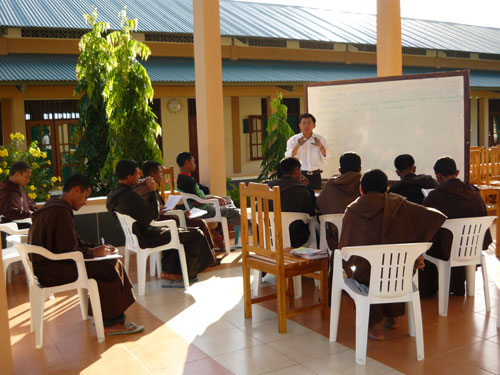
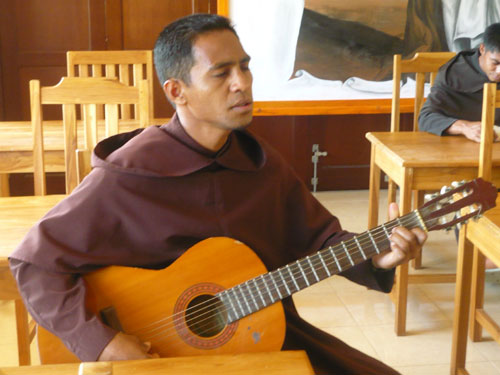
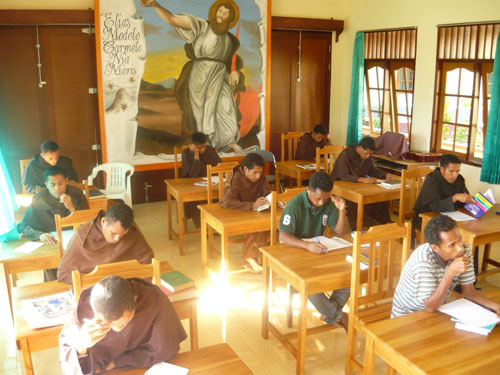
The novitiate is a special time of formation in the Carmelite spirit. During these two years the Novices learn more about the Carmelite Order and its charism and try to grow in a life of prayerful union with God. It is a journey of personal transformation under the guidance of the Holy Spirit, supported by the Novice Director and the Carmelite community.
São Nuno House
 The Carmelite students in Timor-Leste who are preparing for priesthood study at the Diocesan seminary at Fatumeta, Dili. These young Carmelites now study the Portuguese language and take their seminary classes in Portuguese and Tetum, the other national language.
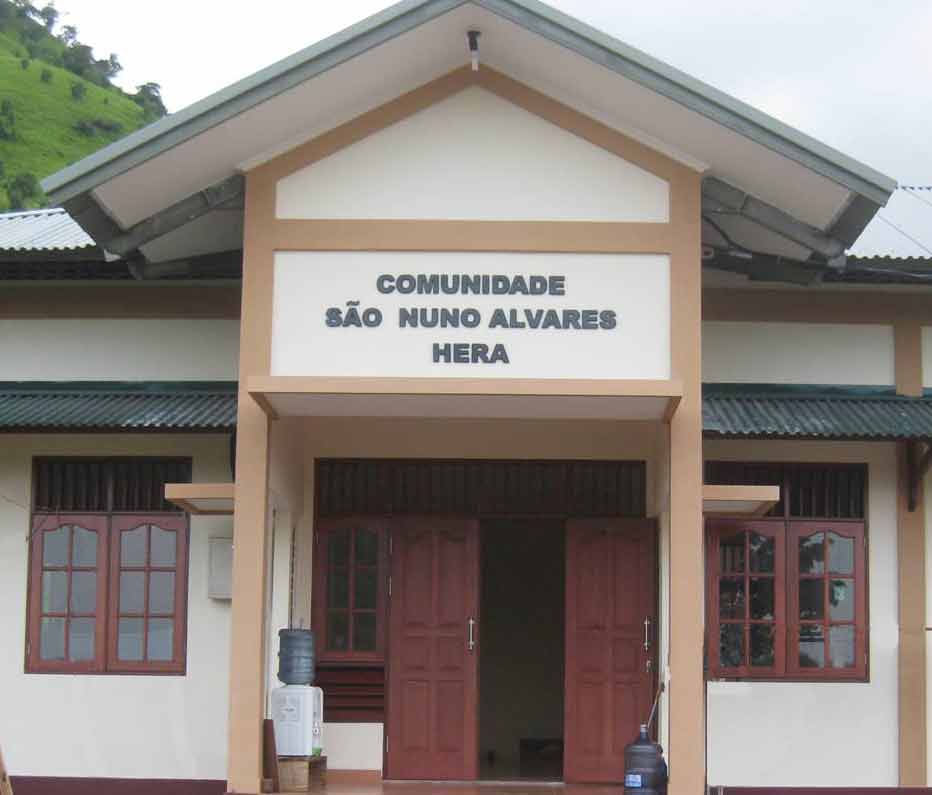
São Nuno House was blessed and opened by Carmelite Prior General, Fr Fernando Millan, in May 2010. It provides accommodation for twelve young Carmelites and two rooms for formators. It is quite close to the Santo Elias building. The new building is named for the Carmelite, Saint Nuno, known as Portugal's "Father of the Nation" and declared a saint by Pope Benedict XVI on 26 April 2010.
Fr Roque Soares da Cruz is the Prior of the community looks after our students in various stages of formation. Fr Fausto Tilman De Araújo is Novice Master and Fr Agostinho Exposto is the Director of our Pre-Novitiate program.
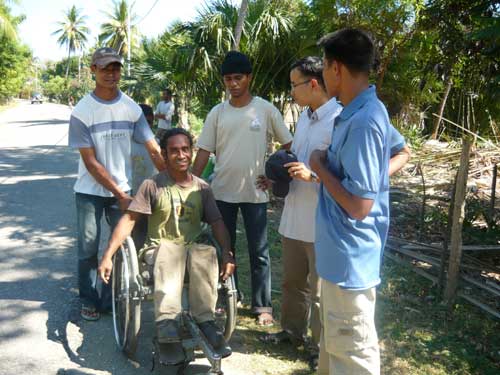
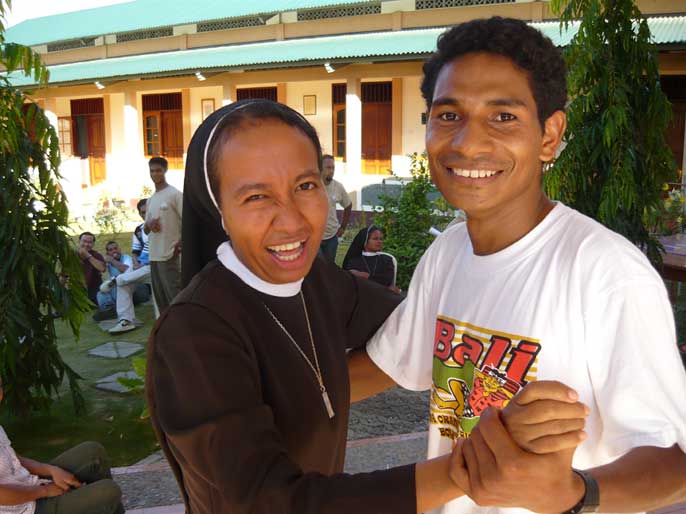
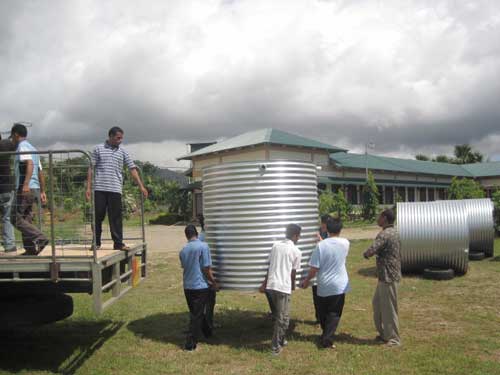
For further information about the Carmelite Formation Programme in Timor-Leste, please contact:
This email address is being protected from spambots. You need JavaScript enabled to view it.
Carmelite Province Centre
75 Wright Street
Middle Park Vic 3206
Telephone: (03) 9699 1922
Fax: (03) 9699 1944
For further information about the Carmelites in Timor-Leste, please contact:
This email address is being protected from spambots. You need JavaScript enabled to view it.
Carmelite Province Centre
75 Wright Street
Middle Park Vic 3206
Telephone: (03) 9699 1922
Fax: (03) 9699 1944
Timor-Leste Mission
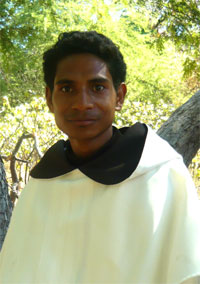 The Carmelite Friars have been in Timor-Leste (East Timor) since January 1999. Two friars from the Indonesian Province, Frs Gheta and Mandius, lived first with the Carmelite Sisters at Maubara about 60 kilometers from Dili. During the final stages of the struggle for independence they witnessed the suffering and hardship of the people and the destruction of the country. In 2000 Bishop Belo asked the Carmelites to go to Zumalai.
In January 2001, the Indonesian Carmelites asked the Australian Carmelites to take responsibility for the Timor-Leste mission and the Parish of Our Lady of Mount Carmel, Zumalai. On 15 August 2001, the Australian Carmelites formally took responsibility for the Timor-Leste Mission.
20 years later, the Timor-Leste Mission is now firmly established with a formation program, a parish in Zumalai, and a community development program.
The Carmelite friars work closely with the Carmelite Sisters in providing pastoral care, health and education services and in community building.
Two Carmelite Centres - Dili & Zumalai
Dili
There are two main Carmelite centres in Timor-Leste. In Dili, the capital of Timor-Leste,
Titus Brandsma House in Fatuhada, a suburb in central Dili, serves as the mission centre and a transit house for Camrelites travelling to and fron the parish of Zumalai. As well as providing accommodation for Carmelites, there are rooms for Carmelite seminarians and for several Community Scholariship recipients from Zumalai.
At Hera, just outside Dili, the Saint Elijah community is the main formation house for young Carmelites in Timor-Leste. Here the novices and professed students live, work and study. The professed students preparing for ministry study at the Diocesan Seminary and other technical centres in Dili. The community has a library and a chapel.
In all, there are over 40 young Timorese Carmelites in formation.
Click here for further information on the Carmelites in Dili
The Parish of Zumalai
The Parish of Our Lady of Mount Carmel, Zumalai, is situated on the south coast of Timor-Leste, near the regional centre of Suai in Covalima Municipality. The parish comprises 8 villages, each of which have their own locally elected village chief and village council. The population is approximately 15,000 people and the median age in the community is 19.5 years old. The Carmelites visit each of the village centres to celebrate mass and the sacraments for the people. During the wet season it is only possible to visit some of the villages.
Connected to the Zumalai parish are three Catholic schools with over 500 students enrolled, and the Beato Tito Brandsma College boarding house which provides accommodation for 24 students each year from remote areas in Zumalai and throughout Timor-Leste.
Click here for further information about the Carmelites in Zumalai
Carmelite community development projects – Carmel Impact
After nearly 2 decades of consistent project work in Timor-Leste, The Carmelites of Australia and Timor-Leste established Carmel Impact in 2019, a charity organization dedicated to transforming lives and helping to build communities in East Timor – one of the poorest countries in the world. This work for change is achieved together with the help of supporters around the globe.
With a focus on education and youth, the aim is to create lasting, positive change in Timor-Leste. Carmel Impact is proud to build on the Carmelites’ legacy in the region, drawing on experience and a wealth of local knowledge. This long-term commitment has built strong relationships with local Timorese communities. Carmel Impact’s community building programs are designed to provide the people of Timor-Leste with the same fundamental human rights all people deserve.
Carmel Impact implements projects that are largely focused on the local rural communities in Zumalai and Hera. There are currently four key program areas:
- Education = Freedom
- Youth Engagement
- Leadership for Change
- Critical Emergency Response

Transforming Lives, Building Communities, Together
Carmelite Mission Support Groups
The Carmelites have established a number of support groups in Australia who are providing friendship and material support to help the people of Timor-Leste.
If you are interested in setting up a group to help the people of Timor-Leste, please use the link below.
For further information about the Carmelites in Timor-Leste, please contact:
This email address is being protected from spambots. You need JavaScript enabled to view it.
75 Wright Street
Middle Park Vic 3205Telephone: (03) 9699 1922
Fax: (03) 9699 1944
Carmelite Communications
Carmelite Communications is a registered business name of the Carmelite Province of Australia and Timor Leste and the imprint under which the Province publishes.
Newsletters and Magazines
- Carmel Contact newsletter of The Carmelites - Australia & East Timor
- JPIC Newsletter from the Carmelite Justice, Peace & Integrity of Creation Commission
- Nubecula a magazine of the Australian Carmelite Province
- Carmelite a magazine of prayer and reflection 1983-1994
Documents of the Carmelite Order
- Towards a Prophetic Brotherhood
Documents of the Carmelite Order 1972-1982
General Chapters
- The Formation of Carmelite Brotherhood
Documents of the Carmelite General Chapter 1983- Carmel 2000: Heritage, Prophecy, Challenge
Documents of the Carmelite General Chapter 1989- Carmel: A Place and a Journey into the Third Millennium
Documents of the Carmelite General Chapter 1995- Carmelite Constitutions
Approved by the General Chapter 1995- Journeying With Carmel
Extracts from the Carmelite Constitutions 1995General Congregations
- Carmel Faced With the Vocational Challenge
Documents of the Carmelite General Congregation 1986- Evangelisation for Carmelites Today
Documents of the Carmelite General Congregation 1992- The Mission of Carmel for the Third Millennium
Documents of the Carmelite General Congregation 1999Councils of the Provinces
- Justice and Peace: An Invitation to Make a Preferential Option for the Poor
Documents of the X Council of Carmelite Provinces 1987- Brotherhood
Documents of the XI Council of Carmelite Provinces 1988- Carmelite Charism: St John of the Cross - memory alive for today
Documents of the XII Council of Carmelite Provinces 1991- The Carmelite Family
Documents of the XIII Council of Carmelite Provinces 1994
Other Publications
-
pdf
2026 Carmelite Liturgical Guide [PDF] |
default
2026 Carmelite Liturgical Guide [ePub]
Carmelite Communications. Published each year since 1983 -
pdf
Lay Carmelite Statutes for Australia & New Zealand - 2020 Edition
Carmelite Communications 2010, 2016, 2021 - In Wonder at the Mystery of God - Contemplation the Lifestream of Carmel
Falco Thuis OCarm 1984 - Letter to the Carmelite Family for the Marian Year
John Malley OCarm 1988 - In Praise of Mary - Services of prayer and reflection for the Marian Year
Archdiocese of Melbourne 1988 - Carmelite Spiritual Directory Project
A project of the International Carmelite Commission for Charism and Spirituality, to promote a new discovery and living out of the specific values of the Carmelite Charism. A series of booklets on various Carmelite themes begun in 2000.
For further information, please contact This email address is being protected from spambots. You need JavaScript enabled to view it..